
Every employer in Tanzania carries a legal duty to provide a safe working environment. That duty is not satisfied by good intentions — it is assessed against what is physically present at your site when an inspector arrives.
This article sets out, in practical terms, the safety equipment Tanzanian workplaces are expected to have, how inspections tend to unfold, and where employers most commonly fall short.
The legal framework in brief
Workplace safety in Tanzania is governed principally by the Occupational Health and Safety Act and administered by the Occupational Safety and Health Authority (OSHA Tanzania). Related bodies shape specific requirements:
- OSHA Tanzania — workplace inspections, registration of workplaces, compliance enforcement
- NEMC — environmental management and monitoring obligations
- TBS — standards to which equipment should conform
- GCLA — control of chemicals and hazardous substances
- Fire and Rescue Force — fire safety certification and equipment
An employer's obligations run in a clear order: eliminate the hazard where possible, engineer it out where elimination is impossible, apply administrative controls, and only then rely on personal protective equipment. PPE is the last line of defence — never the first.
The core PPE checklist
What your workplace needs depends on your hazards. The categories below cover the majority of Tanzanian industrial, construction and mining sites.
Head protection
Safety helmets are mandatory wherever there is a risk of falling objects, overhead work, or striking against fixed objects. Helmets have an expiry date — typically five years from manufacture, less if exposed to sustained sunlight. A cracked or heavily faded helmet offers little protection.
Eye and face protection
Safety spectacles, goggles or face shields are required for grinding, welding, cutting, chemical handling and any work generating dust or projectiles. Welding requires filters of the correct shade number — an ordinary dark lens is not sufficient and permits harmful radiation.
Hearing protection
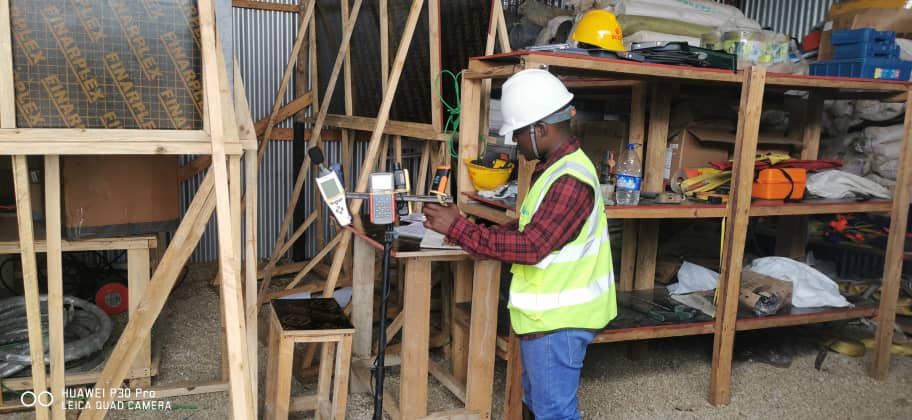
Where noise exposure exceeds the permitted limit over an eight-hour shift, hearing protection becomes mandatory. Critically, you cannot know whether you have exceeded the limit without measuring it. A sound level meter is the equipment that establishes whether a hearing conservation programme is legally required.
Respiratory protection
Dust masks are appropriate for nuisance dust. They are not appropriate for chemical vapours, welding fumes or asbestos. Those hazards require half-mask or full-face respirators with the correct filter cartridge. Fit matters: a respirator that leaks around the seal protects nobody, which is why fit testing exists.
Hand protection
Glove selection follows the hazard — cut-resistant for sharp materials, chemical-resistant for solvents and acids, insulated for electrical work, heat-resistant for hot work. A general-purpose glove used for chemical handling is a common and serious error.
Foot protection
Safety boots with steel or composite toe caps are standard on construction, mining and industrial sites. Where puncture hazards exist, a midsole plate is required. Electrical work demands non-conductive footwear.
High-visibility clothing
Mandatory wherever workers share space with vehicles, plant or mobile equipment. Reflective performance degrades with washing and sun exposure; garments should be replaced when the reflective strips dull.
Fall protection
Work at height requires full-body harnesses, lanyards with shock absorbers, and anchor points rated for the load. Body belts are obsolete and unsafe for fall arrest. Harnesses must be inspected before each use and withdrawn from service immediately after arresting a fall.
Monitoring equipment: the requirement employers overlook
PPE is visible and easy to procure. Monitoring equipment is neither — and it is frequently absent when inspectors arrive.
The principle is straightforward: you cannot manage an exposure you have not measured. If your workplace has noise, dust, heat, chemical vapours or confined spaces, you are expected to have measured them.
- Sound level meters and noise dosimeters — to establish noise exposure and justify hearing protection zones
- Gas detectors — mandatory before and during confined-space entry; four-gas detectors are the standard
- Dust and particulate monitors — for mining, quarrying, cement, milling and woodworking
- Heat stress monitors (WBGT) — relevant across much of Tanzania, particularly in foundries, kitchens and outdoor work
- Light meters — inadequate illumination is a recognised contributory factor in workplace accidents
- Air velocity meters — to verify that ventilation systems actually perform as designed
Where measurement is occasional rather than continuous, hiring equipment is often more economical than purchasing it — provided the instrument arrives calibrated and with a valid certificate.
Fire safety
Requirements typically include serviced fire extinguishers of types appropriate to the hazards present, clearly marked and unobstructed escape routes, functioning emergency lighting, an assembly point, and documented evacuation drills. Extinguishers require annual servicing, and the service record must be available for inspection.
First aid
Workplaces must maintain adequately stocked first aid facilities and trained first aiders in numbers proportionate to the workforce. An expired or depleted first aid kit is a routine inspection finding — and a trivially avoidable one.
Documentation: where most sites lose marks
Equipment alone does not demonstrate compliance. Inspectors examine records. Maintain:
- Workplace registration certificate
- Written risk assessments for each significant hazard
- PPE issue records signed by each worker
- Equipment inspection and maintenance logs
- Calibration certificates for all monitoring instruments
- Training records — induction, task-specific, refresher
- Accident and near-miss register
- Fire drill and emergency evacuation records
- Health surveillance records where exposure warrants them
A site with excellent equipment and no records will struggle in an inspection. A site with good records demonstrates a functioning safety management system.
The most common findings
- PPE issued but not worn. Provision is necessary but insufficient — enforcement and supervision are part of the duty.
- PPE that does not fit. Ill-fitting equipment is removed by workers and therefore protects nobody.
- Expired or damaged equipment still in service. Helmets past their date, harnesses with frayed webbing, extinguishers unserviced.
- Monitoring instruments without valid calibration certificates. An uncalibrated instrument produces readings that mean nothing.
- Missing risk assessments. If the hazard was never assessed, controls cannot be justified.
- Untrained workers. Equipment without training is equipment misused.
A practical starting point
If you are uncertain where your workplace stands, begin here:
- Walk your site and list every hazard, honestly
- Confirm your workplace registration is current
- Audit existing PPE for condition, fit and expiry
- Identify hazards you have never actually measured
- Check calibration status on every monitoring instrument
- Verify fire extinguisher servicing and first aid stock
- Collect your records into one accessible file
- Close the gaps you find, and document that you closed them
Compliance is the floor, not the ceiling
Meeting the legal minimum keeps a site open. It does not, on its own, send every worker home unharmed. The organisations with the strongest safety records treat regulation as a baseline and build a culture above it — one where hazards are reported without fear and near-misses are investigated as seriously as injuries.
GO SAFE Enterprises supplies certified PPE and environmental monitoring equipment across Tanzania, and offers monitoring equipment for hire where continuous ownership is not warranted. With offices in Morogoro and Dar es Salaam, our team can help you specify equipment against your actual hazard profile.
This article is general guidance and does not constitute legal advice. For definitive requirements applicable to your workplace, consult OSHA Tanzania directly.