
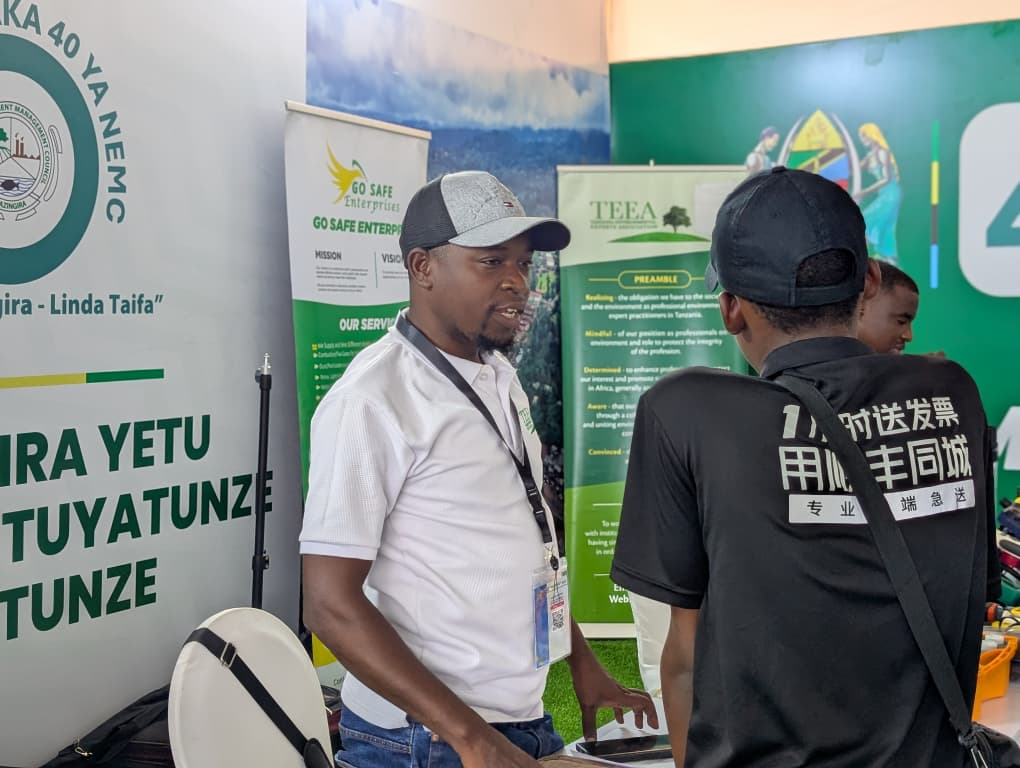
Any significant development project in Tanzania — a mine, a factory, a road, a housing estate, a processing plant — encounters the same requirement early on: an Environmental Impact Assessment. For many investors, particularly those new to the Tanzanian market, the EIA process is treated as a paperwork obstacle to be cleared. That framing is expensive.
An EIA is not a permit exercise. It is a set of commitments a project makes about how it will behave, and those commitments have to be measured, documented and defended for the life of the project.
This article explains who TEEA is, how the EIA landscape fits together in Tanzania, and — practically — what monitoring equipment a project needs to keep its environmental commitments credible.
Who is TEEA?
The Tanzania Environmental Experts Association (TEEA) is a national voluntary membership association representing environmental experts working within Tanzania's environmental sector. It was established in 2017 and is registered under the Societies Act, with its affairs coordinated through the Register of Societies under the Ministry of Home Affairs. Its Annual General Meeting is the association's highest decision-making body, and its office bearers serve voluntarily.
TEEA describes its role as sitting between investors and the key stakeholders in the sector — most notably the Government of Tanzania and the public. In practice, the association performs four functions that matter to anyone running a project:
- It informs. Members are kept current on changes to the laws and regulations governing the environmental sector and the investment industry, and the association organises sector forums.
- It supports regulatory compliance. Members receive updates on local and international regulatory requirements.
- It promotes the profession. TEEA advocates for the role and importance of Environmental Impact Assessment, and positions itself as an industry voice on EIA matters.
- It educates. Investors and stakeholders are the intended audience for its work on why EIA matters for every development project.
You can learn more, review the regulations it publishes, or apply for membership at teea.or.tz.
How the pieces fit together
It helps to be clear about who does what, because these bodies are often confused:
- NEMC (National Environment Management Council) is the regulator. It reviews EIA submissions and oversees environmental compliance.
- TEEA is the professional association for the experts who conduct assessments. It is not the approving authority.
- OSHA Tanzania governs occupational health and safety inside the workplace — a separate but overlapping obligation.
- The Vice President's Office holds the environment portfolio at policy level.
A project therefore has two distinct duties running in parallel: protecting the environment outside the fence (NEMC, EIA) and protecting the workers inside it (OSHA). Both require measurement. Both require equipment. Neither is satisfied by intention.
What an EIA actually commits you to
A completed EIA typically produces an Environmental and Social Management Plan. That plan specifies what the project will monitor, how often, against which limits, and what it will do when a limit is exceeded.
Common commitments include:
- Air quality — dust and particulate matter around the site boundary, gaseous emissions from combustion sources
- Noise — daytime and night-time levels at sensitive receptors such as schools, clinics and residential areas
- Vibration — particularly for blasting, piling and heavy plant near existing structures
- Water quality — effluent discharge, surface water, groundwater near boreholes
- Soil and land — contamination, erosion, rehabilitation progress
- Waste — generation rates, segregation, disposal routes, hazardous waste manifests
The gap between a good EIA and a failed project is rarely the assessment itself. It is the monitoring that was promised and never performed.
Monitoring: the commitment most projects underestimate
Here is the practical difficulty. The EIA is prepared by consultants, submitted, and approved. The consultants move on. The project begins construction. And the monitoring obligations — quarterly dust measurements, boundary noise surveys, effluent sampling — sit in a document that nobody on site has read.
Eighteen months later, a complaint is raised by a neighbouring community, an inspection follows, and the project cannot produce a single measurement to demonstrate that it stayed within its commitments. The absence of data is not neutral. It is treated as non-compliance.
The equipment that prevents this outcome is neither exotic nor especially costly:
- Sound level meters and noise dosimeters — for boundary noise surveys and worker exposure
- Dust and particulate monitors — for PM measurement at receptors and work areas
- Multi-gas detectors and air quality meters — for combustion emissions, confined spaces and ambient monitoring
- Vibration meters — where blasting or piling occurs near structures
- Water quality meters — pH, conductivity, turbidity, dissolved oxygen
- Environmental multimeters — combining temperature, humidity, light and air velocity in a single instrument
- Weather stations — wind speed and direction, which determine how emissions disperse
Buy or hire?
This is a question of frequency, not budget.
If a monitoring obligation recurs continuously — daily dust readings at an active quarry, for instance — ownership is usually justified. The instrument earns its cost within a year, and it is available the moment a complaint arises.
Where the obligation is periodic — a quarterly noise survey, a vibration study during a six-week piling phase, a baseline air quality assessment before construction begins — hiring is generally the more sensible arrangement. You get a calibrated instrument, with a valid certificate, for exactly the period you need it.
Whichever route you take, one requirement does not change: the instrument must carry a valid calibration certificate. A reading taken on an uncalibrated meter is not evidence. It is a number, and it will not survive scrutiny.
Practical advice for project developers
- Engage a qualified expert early. An EIA prepared by someone unfamiliar with Tanzanian requirements will cost you time at review.
- Read your own Environmental and Social Management Plan. Extract the monitoring commitments into a schedule that site staff actually see.
- Establish a baseline before you start. Without pre-construction readings, you cannot demonstrate that any subsequent change was not caused by you.
- Budget for monitoring across the project lifecycle, not just for the assessment.
- Keep calibration certificates filed with the readings. Data and certificate travel together or the data is worthless.
- Train site staff to take readings correctly. An expensive instrument used incorrectly produces confident nonsense.
- Log community complaints and your response. A documented response is a defence; an undocumented one is an allegation.
Compliance as an asset
There is a tendency to treat environmental compliance as a cost centre — money spent to avoid a penalty. Projects that take that view tend to do the minimum, and the minimum tends to be discovered.
The alternative view is more useful. A project with a complete monitoring record has something valuable: evidence. Evidence for the regulator when a complaint is raised. Evidence for lenders and investors, whose environmental and social due diligence is increasingly rigorous. Evidence for the community that the commitments made at consultation were kept.
That record is built one measurement at a time, with instruments that work and certificates that are current.
How GO SAFE Enterprises can help
GO SAFE Enterprises supplies and hires environmental monitoring equipment across Tanzania — sound level meters, dust monitors, gas detectors, vibration meters, water quality instruments and environmental multimeters — alongside a full range of certified PPE.
Whether you need an instrument for a single survey or a monitoring programme running for the life of a project, our teams in Morogoro and Dar es Salaam can advise on the right specification for your Environmental and Social Management Plan.
This article is general information and does not constitute legal or regulatory advice. For definitive requirements applicable to your project, consult NEMC directly. For information about the Tanzania Environmental Experts Association, visit teea.or.tz.